Introduction
In August 1665, the small Caribbean island of Saba fell into English hands during a military expedition against the Dutch possessions in the Lesser Antilles.
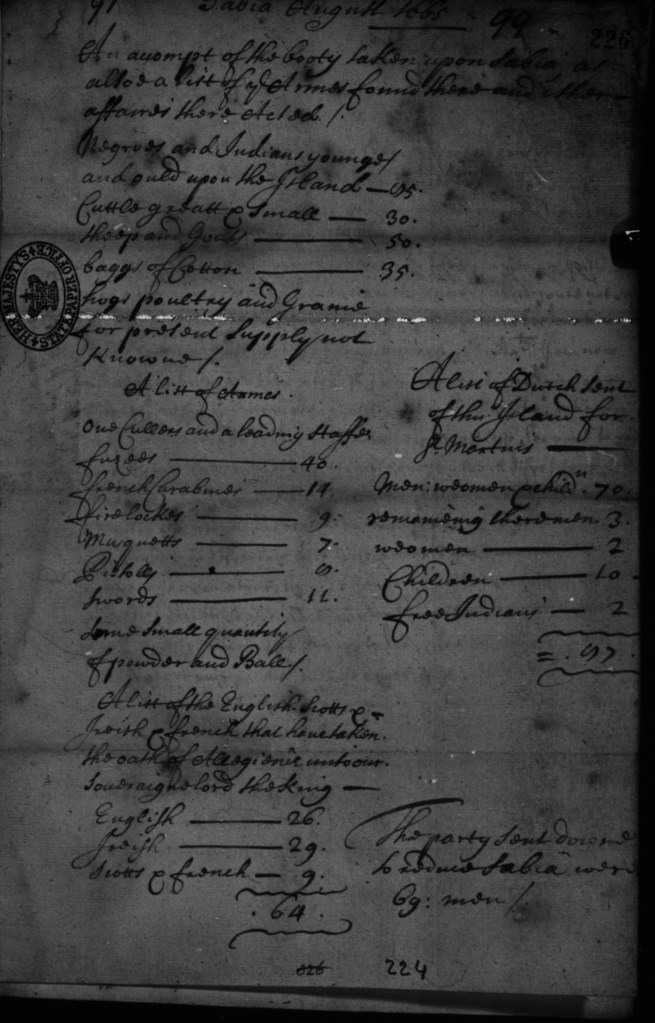
A contemporary document preserved at The National Archives in Kew, London, among the Colonial Office papers (CO 1/19, manuscript page 224), provides a detailed account of the island at the time of its capture.
Entitled Sabia August 1665, it contains an inventory of goods, livestock, and weapons found on the island, along with information about its inhabitants, their nationalities, and their allegiance to the English Crown. It also records the removal of Dutch residents to Saint Martin and the number of men sent to take possession of Saba.
Although brief, this document offers a valuable picture of the island’s population and resources in the mid-seventeenth century.
Historical Background
In 1665, England and the Dutch Republic were engaged in the Second Anglo-Dutch War (1665–1667), a conflict that extended well beyond European waters. In the Caribbean, Dutch trading settlements and colonial possessions became the targets for English attacks.
Sir Thomas Modyford, Governor of Jamaica, organized an expedition against Dutch possessions in the region. Colonel Edward Morgan, Deputy Governor of Jamaica and uncle of the better-known buccaneer Henry Morgan, was the commander.
The expedition left Jamaica in April 1665 with ten ships and approximately 500 men, most of them privateers whose payment depended on the booty they captured, according to the principle of “no purchase, no pay,” as described by Governor Thomas Modyford in a letter of 20 April 1665.
Its intended objectives included the Dutch islands of Saint Eustatius, Saba, and Curaçao.
In July 1665, the English force reached Saint Eustatius, where the Dutch garrison offered little resistance. Edward Morgan died during the operation, apparently overcome by the physical efforts and intense heat. Colonel Theodore Cary subsequently assumed command.
Following the capture of Saint Eustatius, the English turned their attention to nearby Saba. According to a letter written by Governor Thomas Modyford on 16 November 1665, Colonel Theodore Cary sent Major Richard Stevens with a small detachment to take possession of the island, approximately three weeks after the capture of Saint Eustatius.
In a report dated 18 May 1680, Sir William Stapleton gives the precise dates of the two conquests: 23 July 1665 for Saint Eustatius and 5 August 1665 for Saba.
The document reproduced below was drawn up in August 1665 (no exact date), during these events. Beyond its military significance, it provides a detailed account of the people and resources present on Saba at this particular moment in its history.
Transcription of the original English manuscript
Source: The National Archives, Kew, Colonial Office Papers, CO 1/19, manuscript page 224.
The transcription below preserves the original spelling and wording as closely as possible, including the name Sabia. Line breaks follow the manuscript where practical.
No attempt has been made to modernize the language or reconcile numerical discrepancies. The four sections have been numbered for ease of reference, but they are not in the document.
“Sabia August 1665
1.
An accompt of the Booty taken upon Sabia also a list of what was found there and other affaires there etc /.
Negroes and Indians young and old upon the Island — 85.
Cattle great & small — 30.
Sheep and Goats — 50.
baggs of Cotton — 35.
hogs poultry and Graine for present supply not Knowne /.
2.
A list of Armes.
one Cullor and a leading Staffe
fuzees — 40.
French Carabines — 14.
Firelocks — 9.
Musquetts — 7.
Pistols — 9.
Swords — 11.
Some small quantity of powder and Ball /.
3.
A list of the English Scotts & Irish & French that have taken the oath of Allegiance unto our Sovereigne Lord the King —
English — 26.
Irish — 29.
Scotts & French — 9.
———
4.
A list of Dutch sent of this Island for St Martins —
Men women & child[ren] — 70.
remaining (Here?) men — 3.
women — 2.
Children — 10.
free Indians — 2.
———
87
Final annotation – (At the bottom right of the manuscript):
The party sent downe to reduce Sabia were 69 men /.”
Glossary
The following explanations clarify some of the military terminology and expressions used in the 1665 manuscript.
Cullor (Colour): A military flag or standard identifying a company or unit. Carried into battle or displayed at a garrison, these flags served as important visual rallying points for soldiers in the field.
Leading Staffe: Probably a staff or polearm carried by infantry officers or sergeants as a symbol of rank and authority. Such weapons, including half-pikes, partisans and halberds, could also be used to direct troop movements. The precise meaning of the expression in this manuscript remains uncertain.
Fuzees (Fusils): Light, smoothbore long guns that were smaller and more maneuverable than standard infantry muskets. By the mid-seventeenth century, the term was associated with lighter firearms, often employing flintlock ignition mechanisms rather than the traditional burning match.
French Carabines: Relatively short and light firearms of French manufacture or pattern. Carbines were commonly associated with mounted troops, though their compact size also made them practical aboard ships or in confined spaces. The manuscript does not specify their exact design or firing mechanisms.
Firelocks: A general term for firearms using a mechanism that produced sparks to ignite the gunpowder, rather than a continuously burning match. In the seventeenth century, the term could refer to weapons equipped with wheel-lock or flintlock mechanisms.
Musquetts (Muskets): The standard long firearms carried by infantry. During much of the seventeenth century, many muskets employed the traditional matchlock mechanism, which required a continuously burning match-cord. Flintlock muskets were also coming into use during this period.
Pistols: Short firearms designed to be held and fired with one hand, typically at close range. In this period, they were generally single-shot weapons that used various ignition mechanisms and were frequently carried by officers and mounted soldiers.
Powder and Ball: The essential components of seventeenth-century firearm ammunition: black gunpowder and spherical lead projectiles.
Booty: Goods, weapons, livestock or other property captured or seized from an enemy during a military operation, often inventoried for subsequent distribution or official use. Booty also included humans at the time.
Oath of Allegiance: A formal declaration of loyalty to a sovereign. In this context, the oath acknowledged the authority of the English Crown following the conquest of Saba. The manuscript does not specify the conditions under which the oath was taken.
To reduce: A standard seventeenth-century military term meaning to capture, subdue or bring a place or territory under control, whether by force or surrender. The final annotation records the number of men dispatched to « reduce Sabia » under English authority.
What the Document Reveals
Although only a single manuscript page, the August 1665 document provides a remarkably detailed account of Saba at the time of its conquest by the English. Beyond the inventory of captured property, it offers valuable information about the island’s resources, its military equipment and, most importantly, the composition of its population. Such documents are rare concerning small islands like Saba or St Barth.
The Island’s Resources
The first section records livestock, agricultural produce and provisions found on Saba. The presence of 30 cattle, 50 sheep and goats, and 35 bags of cotton suggests an established agricultural community rather than a temporary settlement.
Cotton is particularly noteworthy. Its inclusion among the goods taken by the English indicates that it was sufficiently valuable to be counted separately. However, the document does not establish whether the cotton was grown entirely on Saba or whether some had been brought from elsewhere.
The quantities of pigs, poultry and grain were not recorded, apparently because these supplies were intended for immediate use by the occupying force.
The inventory therefore provides a glimpse of the island’s economic activity, although it cannot be considered a complete assessment of its agricultural production or wealth.
Weapons and Military Preparedness
The second section lists a substantial collection of weapons for such a small island: 70 long firearms, including 40 fuzees, 14 French carbines, nine firelocks and seven muskets, together with nine pistols and eleven swords.
The presence of a military color and a leading staff also suggests some form of organized military force, perhaps a local militia.
Nevertheless, the inventory raises several questions. Were all these weapons serviceable? Did they belong to the Dutch authorities, to individual inhabitants, or to a local militia? And how many men were actually available to use them?
The manuscript provides no answers.
Nor does the existence of these weapons demonstrate that the inhabitants offered armed resistance. The quantity of gunpowder and ammunition is described only as small, with no further detail.
A Population of Several Nationalities
Perhaps the most revealing part of the document is the list of inhabitants who swore allegiance to the English king.
Of the 64 individuals recorded, 26 were English, 29 Irish, and nine were grouped together as Scots and French.
The Irish were therefore the largest single nationality identified among those taking the oath, representing approximately 45 percent of the total. This is an important observation. It provides direct documentary evidence of a substantial Irish presence on Saba in August 1665, independent of traditions about the island’s earliest European settlers. However, the figures require careful interpretation. The list does not specify whether it included women, whether it counted children, or how long these individuals had lived on the island.
Nor does the document explain why it grouped Scots and French inhabitants together while counting the English and Irish separately.
The Dutch Inhabitants and Their Removal to Saint Martin
The fourth section provides a particularly interesting account of what happened to the Dutch population following the English conquest.
Of the 87 individuals recorded, 70 men, women, and children were sent from Saba to Saint Martin. The remaining Dutch population consisted of three men, two women, and ten children, together with two free Indigenous people. Therefore, the document shows that the English did not expel the entire Dutch population. A small group was allowed to remain on Saba, although the circumstances of their decision, or the conditions imposed upon them, are not explained.
The manuscript does not indicate how the 70 people were selected for removal, whether they were transported against their will in every case, or what became of them after their arrival in Saint Martin.
Nevertheless, it establishes a direct movement of inhabitants between the two islands as a consequence of the English conquest.
The separate mention of two free Indigenous people is also significant, particularly when compared with the enslaved population recorded in the opening inventory.
The manuscript explicitly identifies only 17 inhabitants as remaining on Saba. The 64 English, Irish, Scottish and French residents who swore allegiance to the English Crown must also have remained, but the manuscript does not explicitly confirm it. This would bring the estimated number of free inhabitants remaining on the island to 81. The fate of the slaves is not specified.
The Enslaved Population
The first section records 85 people described as “Negroes and Indians young and old upon the Island.”
Their inclusion in the inventory of booty, alongside livestock, cotton, and other property, confirms the English regarded these individuals as possessions that could be seized during a military operation. This was consistent with the practice of slavery in the seventeenth-century Caribbean, as discussed in some other articles on this blog concerning similar English attacks on St. Barth.
The manuscript provides no distinction between men, women, and children. Despite it seeming to distinguish slaves of different origins, it does not indicate how many of the 85 were Africans and how many were Indigenous people. The expression young and old nevertheless makes clear that individuals of different ages were included.
The separate identification of two “free Indians” among those remaining on Saba reinforces this distinction. It shows that the writer recognized the presence of free Indigenous inhabitants alongside those included in the inventory of enslaved people.
The document does not explain what happened to the 85 enslaved individuals after the conquest. However, some other documents suggest they were, partly or wholly, removed from Saba and sold elsewhere.
The English Force Sent to Capture Saba
The final annotation provides another important detail:
“The party sent downe to reduce Sabia were 69 men.”
This establishes that the force dispatched to bring Saba under English control numbered 69 men.
However, the annotation does not describe the operation itself. The manuscript gives no indication of the exact date of landing, the identity of the commanding officer, the duration of the expedition, or whether any fighting occurred.
Comparison with Published Historical Accounts
The following table compares the figures and information recorded in the August 1665 manuscript with those found in historical publications. It highlights several discrepancies, particularly concerning the population of Saba and the removal of its Dutch inhabitants.
| Subject | Published historical accounts | Original manuscript (1665) |
| Total population | 226 inhabitants (Price, 1934) | 236 inhabitants |
| Dutch and free Indigenous inhabitants | 87 (Price, 1934) | 87 |
| English, Irish, Scottish and French inhabitants | 54 (Price, 1934) | 64 |
| Enslaved Africans and Indigenous people | 85 (Price, 1934) | 85 |
| Irish inhabitants | Not separately identified | 29 |
| Dutch inhabitants removed to Saint Martin | 87, with enslaved people (Hartog, 1975) | 70 |
| Inhabitants remaining on Saba | Not specified (Hartog, 1975) | 81 presumed (64 who took the oath of allegiance and 17 others who remained) |
| English expeditionary force sent to Saba | 70 men (Haring, 1910) | 69 men |
| Military equipment | No complete inventory identified | 70 long firearms, 9 pistols, 11 swords |
| Livestock and cotton | Partially recorded in historical accounts | 30 cattle, 50 sheep and goats, 35 bags of cotton |
The English Conquest of 1665 in Historical Accounts
Several historians have described the English capture of Saba in 1665, though their accounts differ in certain details, particularly regarding the island’s population and the fate of its inhabitants.
Comparing these publications with the original manuscript reveals several discrepancies.
The Capture of the Island
In The Buccaneers in the West Indies in the XVII Century (1910), C. H. Haring describes the expedition against Saint Eustatius under Colonel Edward Morgan and the subsequent occupation of Saba.
Following Morgan’s death, Colonel Carey assumed command of the English forces. According to Haring, a detachment of 70 men crossed from Saint Eustatius to Saba and obtained its surrender under the same conditions as those imposed on Saint Eustatius.
The manuscript gives a slightly different figure: 69 men were sent to reduce Saba. The difference is minor and may simply reflect Haring’s use of a rounded number.
Haring also describes the disagreements among the English forces over the distribution of booty, which contributed to the decision to abandon plans for further conquests.
In his History of Saba, first published in 1975, J. Hartog identifies the Mayflower as the vessel that occupied Saba.
The manuscript does not identify the vessel or the officer commanding the detachment, but it confirms that 69 men were dispatched. Other contemporary correspondence identifies Major Richard Stevens as the officer sent to take possession of the island.
The Population Figures
A more significant discrepancy concerns Saba’s population.
The Encyclopaedie van Nederlandsch West-Indië (1914–1917), drawing on earlier historical research, records 87 Dutch inhabitants, 54 English, Irish and Scottish inhabitants, and 85 Africans and Indigenous people.
A. Grenfell Price repeats these figures in his article White Settlement in Saba Island, Dutch West Indies, published in the Geographical Review in 1934.
These figures produce a total population of 226 people.
The original manuscript, however, records 64 English, Irish, Scottish and French inhabitants who swore allegiance to the English Crown, rather than 54.
The difference is significant. According to the manuscript, Saba’s population numbered 236 people in August 1665:
- 64 English, Irish, Scottish and French inhabitants;
- 85 Dutch inhabitants;
- two free Indigenous people;
- 85 enslaved Africans and Indigenous people.
The total of 236 is therefore ten higher than the figure obtained from the numbers reproduced in the earlier publications.
The manuscript also provides a more detailed breakdown of the inhabitants who swore allegiance: 26 English, 29 Irish, and nine Scots and French.
These distinctions, particularly the separate identification of 29 Irish inhabitants, are absent from the population figures Price reproduced.
The Removal of the Dutch Population
The fate of the Dutch inhabitants presents another important difference.
Hartog states that the 87 Dutch settlers, together with their enslaved people, were deported to Saint Martin, while the English, Scottish and Irish inhabitants were left undisturbed.
The manuscript provides a more precise account.
It records 70 Dutch men, women, and children sent to Saint Martin, and clearly states that another group of Dutch inhabitants included three men, two women, and ten children, along with two free Indigenous people who stayed behind.
Thus, while 70 people were removed from Saba, 17 remained on the island.
This distinction is important because it shows that the removal of the Dutch population was not complete, contrary to the impression given by some later historical accounts.
The manuscript does not establish whether the 17 inhabitants remained voluntarily or under conditions imposed by the English.
The fate of the 85 enslaved people presents a separate question. Although they appear in the inventory of booty, the document does not indicate their destination or what happened to them afterward. The statement that the Dutch inhabitants were deported together with their enslaved people therefore requires further examination.
What Does the Comparison Tell Us?
The historical accounts and the manuscript agree on the key event: Saba came under English control in August 1665, following the capture of Saint Eustatius.
However, the original document provides greater precision concerning the expeditionary force, the population and the consequences of the conquest.
The difference between 54 and 64 inhabitants in the English, Irish, Scottish and French group explains the discrepancy between the published population figure of 226 and the manuscript total of 236.
Similarly, the distinction between the 70 Dutch inhabitants sent to Saint Martin and the 17 people who remained on Saba corrects the impression that the entire Dutch population was expelled.
These differences do not fundamentally change the history of the English conquest, but they demonstrate the importance of returning to contemporary documents rather than relying exclusively on figures repeated in later publications.
The August 1665 manuscript allows us to recover details that have been simplified, omitted or misreported in some historical accounts.
The Months Following the English Conquest
The capture of Saba was not intended to be merely a temporary raid. In his letter of 23 August 1665, Colonel Theodore Cary reported that a small garrison had been established on the island, as well as on the nearby island of Saint Eustatius, pending further instructions from the English authorities.
The fate of the enslaved population also becomes somewhat clearer, although important uncertainties remain. In October, a report reaching England claimed that approximately 1,800 enslaved people had been taken from Saint Eustatius and Saba, most of whom had reportedly been sold at Saint Christopher. In November, Modyford reported that approximately 900 enslaved people had been captured during the expedition, of whom 500 had reached Jamaica.
These accounts differ considerably in their figures, and neither identifies the individuals taken specifically from Saba. Consequently, we cannot establish what happened to the 85 enslaved Africans and Indigenous people recorded in the August inventory, nor can we assume that they were transported to Saint-Martin. Nevertheless, the correspondence confirms that the conquest of the two islands was accompanied by the removal and redistribution of enslaved people.
Meanwhile, the English authorities began considering the future of their new possessions. On 10 October 1665, the Council of Jamaica ordered that the plantations of Saint Eustatius and Saba be sold to English settlers, while reserving the rights of the Crown. Instructions issued in November also called for the continued settlement of the islands and the dispersal of Dutch inhabitants among other English plantations.
These decisions reveal an intention to establish lasting English control.
By the end of 1665, Saba had therefore become more than the object of a successful military expedition. Its population had been disrupted, some inhabitants had been removed, and English authorities were already planning its administration and settlement.
By January 1666, disagreements had also emerged among the English authorities themselves. Lord Willoughby, Governor of Barbados, complained that the men who had conquered Saint Eustatius and Saba claimed to act under Modyford’s commission and refused to acknowledge his own authority. The administration of the newly conquered islands was therefore already disputed.
What Do the Dutch Archives Tell Us?
The Dutch archives provide considerably less information about the English capture of Saba than the surviving English correspondence. Nevertheless, several documents refer to the loss of the island and its neighboring Dutch possessions.
A letter from Curaçao, dated 10 October 1665 and preserved among papers received in January 1666, reports the arrival of nine English ships from Jamaica and the capture of Saint Eustatius. It does not, however, mention the attack on Saba.
A later memorandum preserved in the Zeeland archives explicitly mentions the English capture of Saba around mid-1665, alongside other Dutch possessions. Although it confirms that Dutch sources recorded the conquest, it offers no details about the military operation or the fate of the island’s inhabitants.
Finally, a petition submitted by Dutch merchants and shipowners lists Saba and Saint Eustatius among several lost possessions. The document is not securely dated and provides no information about the circumstances of their capture.
Despite an extensive search of the available digitized Dutch records, no contemporary account of the English attack on Saba itself has been identified. Nor have I found any Dutch document recording the arrival at Saint Martin of the 70 inhabitants the English manuscript states were sent there, or indicating what happened to them afterward.
Such records may exist in collections that have not yet been digitized, indexed or examined. Their absence from the material consulted cannot be taken as evidence that these events did not occur. For the time being, however, the English manuscript remains our only identified direct source.
English records also indicate that 250 Dutch men, women and children were sent from Saint Eustatius to Saint Martin during the same expedition, bringing the total number of people reportedly transferred from the two islands to 320. One would expect to find traces of this rather important arrival on St Martin.
What Can We Conclude?
The English capture of Saba in August 1665 is relatively well documented, yet several aspects of the operation remain uncertain. The surviving manuscript does not describe the landing or the circumstances of the island’s surrender, but it provides an unusually detailed record of its inhabitants, resources, weapons and the immediate consequences of the conquest.
Its figures also allow us to correct or qualify information repeated in later historical accounts. The 64 English, Irish, Scottish and French inhabitants who took the oath of allegiance, the 70 people sent to Saint Martin and the 17 who remained on Saba offer a more precise picture than the figures generally reproduced by historians.
The identification of 29 Irish inhabitants is particularly significant, although it tells us nothing about when their families first settled on the island.
The English correspondence adds further details. It identifies Major Richard Stevens as the officer sent to take Saba, confirms that a small garrison was established and reveals the plans made for the island’s future administration. It also shows that the conquest of Saba and Saint Eustatius formed part of a much wider displacement and redistribution of enslaved people.
Yet much remains unknown, particularly the fate of those recorded in Saba’s inventory.
Taken together, these documents allow us to move beyond the traditional accounts of the conquest. They do not provide a complete history of Saba in 1665, but they bring us much closer to understanding the island and its inhabitants when English forces took control.
What happened during the following year, and how English rule eventually came to an end, belongs to the next chapter of Saba’s history.
Sources and References
Original manuscript
- The National Archives, Kew, London. Colonial Office Papers, CO 1/19, manuscript p. 224, “Sabia August 1665.” Original inventory of the booty, inhabitants, weapons and resources recorded following the English capture of Saba.
Contemporary English correspondence
- Calendar of State Papers, Colonial Series, America and West Indies, Vol. V, 1661–1668. Particularly documents nos. 979, 1042, 1045, 1063, 1066, 1079, 1082, 1085 and 1125, concerning the expedition from Jamaica, the conquest of Saint Eustatius and Saba, the population and booty, the subsequent English administration and the disagreements between colonial authorities.
Dutch archival references
- 10 October 1665: Correspondence from Curaçao concerning the English capture of Saint Eustatius. Nationaal Archief, Staten-Generaal, 1.01.02, inv. 5768, image 23
- Undated memorandum, concerning events of 1665–1666: Account of English conquests and subsequent changes of possession in the Caribbean, including Saba. Zeeuws Archief, fonds 33.1, inv. 1626, images 38–39.
- Undated petition, probably after September 1664: Petition by Dutch merchants and shipowners mentioning Saba and Saint Eustatius among lost possessions. Nationaal Archief, Staten-Generaal, 1.01.02, inv. 5768.
Published historical works
- Haring, C. H. (1910). The Buccaneers in the West Indies in the XVII Century. London: Methuen & Co.
- Encyclopaedie van Nederlandsch West-Indië (1914–1917). Edited by H. D. Benjamins and Joh. F. Snelleman.
- Price, A. Grenfell (1934). “White Settlement in Saba Island, Dutch West Indies.” Geographical Review, Vol. 24, No. 1, pp. 42–60.
- Hartog, J. (1975). History of Saba.
The transcription of the August 1665 manuscript is based on the original archival document rather than the summary published in the Calendar of State Papers. The historical accounts cited above have been compared with the manuscript wherever relevant, particularly regarding population figures, the removal of inhabitants, and the English force sent to capture the island.
Catégories :1665, Dutch, SABA, SABANS, Uncategorized


Votre commentaire