An archival document raises questions about Saba’s first European settlers, the length of English occupation, and the fate of the islanders.
To Will Johnson, the best bush lawyer in the islands.
Introduction
The early history of European settlement on Saba remains somewhat uncertain. Although the island is generally considered to have been colonized by Dutch settlers from neighboring St. Eustatius around 1640, historians have also acknowledged the presence of English, Irish, and Scottish inhabitants in the seventeenth century.
The dates of Saba’s different occupations have likewise been the subject of some confusion, particularly regarding the period during which the island remained under English control after its capture in 1672.
An English document written in July 1680 provides an interesting contemporary perspective on both questions.
Entitled An Account of the Islands of Saba and Statia, the manuscript is preserved among the British Colonial Papers, under the reference CO 1/45, document no. 69.
Unlike many of the early descriptions of these islands, which come from the writings of travelers, missionaries, or chroniclers, this document is an administrative report prepared for the English authorities in London. It summarizes the history of Saba and St. Eustatius and the diplomatic exchanges surrounding their restitution to the Dutch.
Its authors were principally concerned with explaining why the two islands had remained under English control despite the peace treaty concluded several years earlier.
Nevertheless, the report contains a statement about the origins of European settlement that deserves attention. It asserts that the English first settled the islands before the Dutch took them during the First Anglo-Dutch War.
It also explains the English authorities’ reluctance to surrender the islands, particularly for fear that the French might subsequently occupy them.
Finally, the document provides a glimpse into the circumstances of the inhabitants themselves, who apparently showed little enthusiasm for leaving their island despite the approaching change of sovereignty.
The following transcription is followed by an examination of these three points in light of other contemporary records and the work of historians who have studied Saba.
The document: An Account of the Islands of Saba and Statia, July 1680
A note on the source
The transcription presented here was prepared directly from photographs of the original manuscript (CO 1/45, no. 69), rather than from the published entry in the Calendar of State Papers Colonial (1677–1680, no. 1472). The Calendar provides an edited account of the document, whereas consulting the manuscript allows us to examine its original wording, spelling, corrections, and marginal annotations.
The transcription preserves most of the manuscript’s original wording and spelling, including grammatical irregularities. Some abbreviations have been expanded for readability. Editorial observations and uncertain readings are indicated separately.
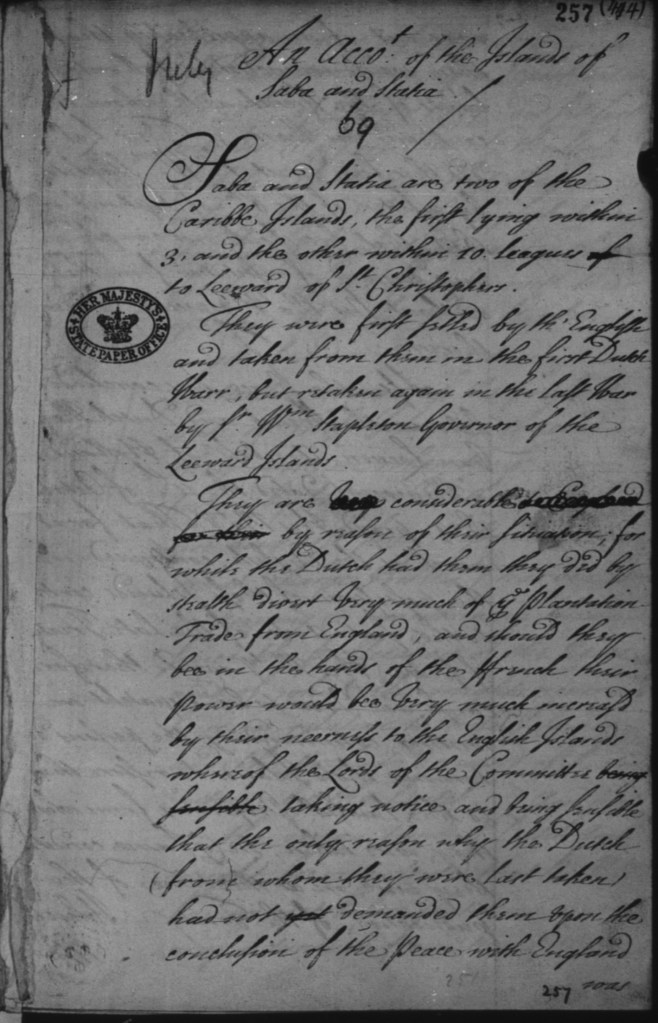
Manuscript page 257
July
An Accoᵗ of the Islands of Saba and Statia
Saba and Statia are two of the Caribbee Islands, the first lying within 3. and the other within 10. leagues to Leeward of St. Christophers.
They were first settled by the English and taken from them in the first Dutch War; but retaken again in the last War by Sr Wm Stapleton Governor of the Leeward Islands.
They are considerable [altered wording] by reason of their situation, for whilst the Dutch held them they did by stealth divert very much of the Plantation Trade from England, and should they bee in the hands of the French their power would be very much increased by their nearness to the English Islands, whereof the Lords of the Committee being sensible, taking notice, and being satisfy’d that the only reason why the Dutch (from whom they were last taken) had not demanded them upon the conclusion of the Peace with England […]
Manuscript page 258, left
[…] was out of an apprehension that they would immediately fall into the hands of the French with whom they continued in war. Their Lordships did therefore direct Sr Wm Stapleton by a letter of the 6th of September 1677, that he should not comply with any demand of restitution from the Dutch without His Majesty’s special Order therein.
After the Peace was concluded between the French and Dutch, Monsr Van Leeuwen, Ambassador of Holland by a Memorial dated the 11th of October 1679, prayed His Majesty that forasmuch as the English continued in the possession of those Islands contrary to the sixth Article of the last Treaty of Peace, His Majesty would therefore confirm an Order to be dispatched in writing commanding the persons detaining those Islands to restore them to the lawfull Proprietors from whom they were taken, in the same condition they were in at the time of the publication of the Treaty. Which […]
Manuscript page 258, right
[…] Memorial was referred unto a Committee of Plantations who by a Report dated the 30th of October 1679 did set forth unto his Majesty in Council the State of these Islands and that they were only detained by the English because the Dutch had not demanded them for fear of the French, with their opinion that Sr Wm Stapleton might be directed to return a particular account of the present state of those Islands, the condition they were in when they were taken by him. Whether there has been any cost since bestowed on them. What charges His Majesty has bin at in keeping & maintaining them since the publication of the Peace, and of what else might occur unto him in relation to those Islands, and the present demand of Restitution by the Dutch. And that in the mean time the Dutch Ambassador might be acquainted that His Majesty having not before that time received any intimation from the States of […]
Manuscript page 259, left
[…] of their desires to bee repossest of those Islands, had now directed his Govr in whose hands they were to certify unto him with all speed the condition they were in, and that his Majesty upon receiving his answer and enabling himselfe thereby to dispose of his Subjects in some other fit place would then give such Order for the Restitution of these Islands, as the Treaty with the States and the particular Justice of their case should require.
Which Report being approved in Council on the sixth of November following, It was ordered that the Committee of Plantations should signify the abovementioned Directions unto Sr Wm Stapleton, and that the Earl of Sunderland should give such Intimations unto the Dutch Ambassador as is mentioned in the said Report.
Sr W. Stapleton has accordingly by a letter dated the 18th of May last acquainted the Committee of Plantations […]
Marginal annotation: “Read 21 Jul”, written over an earlier, fading note apparently reading “18 May 1680”.
Manuscript page 259, right
[…] that He had sent an Express to these Islands to inquire into the past and present state thereof. That it is not possible to restore them in the condition they were taken [wording altered], for that after they were possessed by him. Myn Heer Binck & Everson retook Statia, plundered their own nation and the English that were there. That afterward some poor people left upon it for their Poverty with some others that went thither since the last Peace put themselves under His Majesty Protection against the French.
That all the charge he has been at is 16000 Sugar worth 100 St. and 50 musquets. That Saba is in a better condition than when taken and that how soon They be restored imports not much. That in the mean time he will endeavour to gett off as many English […]
Manuscript page 260, left
[…] as he can to St Christophers or Antigua or any other Island but that They are not very desirous to come away. That his care must be to hinder their trading which he believes may be the design of the States or the Proprietors having now no other Sugar Colony in these parts except Surinam where they are much streightned by the Indians.
Marginal annotation: “July about the 21st – [end of month?]”.
The remainder of the photographic sequence begins a separate document concerning Virginia and does not form part of the account of Saba and St. Eustatius.
1. Who were the first European settlers of Saba?
The most striking statement in the report appears near the beginning:
They were first settled by the English and taken from them in the first Dutch War; but retaken again in the last War by Sr. Wm. Stapleton, Governor of the Leeward Islands.
The document therefore attributes the initial European settlement of both Saba and St. Eustatius to the English.
The reference to the First Anglo-Dutch War, which lasted from 1652 to 1654, is particularly interesting. According to this account, the English had established themselves on both islands before the war, and the Dutch took possession of them during the conflict.
This places the first English settlement of Saba before 1652, earlier than the period generally associated with the arrival of English-speaking settlers in the island’s traditional historical accounts.
This does not necessarily mean that the English were the first Europeans ever to visit or occupy the island. Nor does the report identify the settlers, their place of origin, or the exact year of their arrival.
Nevertheless, the assertion deserves consideration because it appears in an official English document dating from 1680, not in a historical interpretation written centuries later.
What do the historians say?
The traditional account of Saba’s early European settlement generally attributes its colonization to Dutch settlers from St. Eustatius around 1640. This interpretation appears in the works of several historians, including J. H. J. Hamelberg, L. Knappert, A. Grenfell Price, and Johan Hartog.
Several of these authors refer to Charles de Rochefort, whose Histoire naturelle et morale des îles Antilles de l’Amérique, first published in 1658, describes the establishment of a settlement on Saba by men sent from St. Eustatius.
However, an important distinction has often been overlooked.
Rochefort does not say that these settlers were Dutch. He merely states that they came from St. Eustatius, an island under Dutch administration. Later historians appear to have interpreted their place of departure as evidence of their nationality. Yet the two are not necessarily the same. A Dutch-governed colony could have included settlers from several European countries.
Rochefort provides no date for their arrival, nor does he claim that they were Saba’s first European settlers. His account therefore cannot, by itself, establish either the Dutch nationality of these colonists or the generally accepted date of around 1640.
See also our recent article on Charles de Rochefort’s 1658 publication and his descriptions of the Northern Leeward Islands.
Hamelberg’s arguments
In his Historische schets van de Nederlandsche Bovenwindsche Antillen (1898, p. 113), J. H. J. Hamelberg wrote:
« Saba werd door de Hollanders van St. Eustatius gekoloniseerd, waarschijnlijk omstreeks 1640. »
In English: « Saba was colonized by Dutch settlers from St. Eustatius, probably around 1640. »
Hamelberg acknowledged that some earlier writers attributed Saba’s settlement to Presbyterian refugees expelled from England during the reigns of Elizabeth I and Charles I. He rejected this tradition for two principal reasons.
First, he maintained that England had never claimed Saba. In his opinion, this would have been unlikely if English settlers had established the colony or formed the majority of its population for a considerable period, particularly at a time when European powers frequently fought over the smallest Caribbean islands.
Second, he questioned the supposed Presbyterian origins of the inhabitants. He referred to church registers from St. Eustatius, beginning in 1709, which, according to him, showed that most of Saba’s inhabitants belonged to the Dutch Reformed Church. He also pointed to the predominance of Dutch or apparently Dutch family names and the regular visits of Dutch ministers to Saba.
These arguments, however, are not particularly convincing as evidence of the nationality of the island’s first European settlers.
The church registers begin approximately seventy years after the supposed settlement of 1640. They provide valuable information about Saba’s population in the eighteenth century, but cannot establish the origins of the earliest settlers.
Nor does the use of Dutch Reformed ministers necessarily demonstrate Dutch ancestry. Presbyterians and members of the Dutch Reformed Church belonged to closely related Protestant traditions. In the absence of a Presbyterian minister, English-speaking or Scottish families could have turned to a Dutch Reformed minister for baptisms, marriages, and other religious services.
The argument based on family names is equally uncertain. Surnames could change as they passed between languages or were recorded by officials unfamiliar with their original pronunciation. Dutch names could become anglicized, but the reverse was also possible. Without tracing individual families through earlier records, the appearance of Dutch surnames in eighteenth-century documents cannot establish the nationality of Saba’s first settlers.
Different oral traditions
Hamelberg also referred to a local tradition according to which Saba’s first settlers established themselves on the southern coast, where they built a village and a fort. A landslide supposedly buried both the houses and the fort, killing several inhabitants. He considered the survival of the name Fortweg, or Fort Road, as support for this tradition.
However, local oral traditions do not all tell the same story.
The Saban historian Will Johnson recorded a different tradition, passed down through generations, in which Irish settlers from St. Kitts reached Saba after the Spanish attack of 1629. According to this account, they established settlements at Palmetto Point and Middle Island.
This refugee movement would not have been unusual under the circumstances. Following the Spanish attack on St. Kitts in 1629, French settlers also sought refuge on neighboring islands. Guillaume Coppier, for example, described spending approximately two months on St. Martin (see my article about his account), while Pierre Belain d’Esnambuc, the French commander of St. Kitts, took refuge on Antigua.
This tradition cannot be considered proof of an Irish settlement in 1629. Nevertheless, it deserves attention, just as the tradition concerning the settlement near Fort Bay deserves attention. Neither can establish, on its own, the nationality of Saba’s earliest European settlers.
Johnson also refers to a petition reportedly sent to the Dutch West India Company in 1659, in which Saba’s inhabitants requested a clergyman who knew English. The original document has not yet been located, but its existence, if confirmed, would provide important contemporary evidence of an English-speaking community on Saba before the English capture of the island in 1665.
In his historical writings, Johnson also cites a 1999 publication by Jacqueline Bakker and Ron van der Veer, according to which the Zeeland entrepreneurs involved in the colonization of St. Eustatius recruited settlers from several European backgrounds, including Irish and Scottish colonists.
The original passage and its sources remain to be verified, but the distinction matters: a colonization enterprise organized by Dutch merchants does not necessarily mean that all the settlers were Dutch. English-speaking settlers recruited by these merchants could therefore have reached Saba by way of St. Eustatius, as described by Rochefort.
Will Johnson has long emphasized the importance of Saba’s English-speaking population and questioned the predominantly Dutch interpretation of the island’s early history. The report of 1680 does not establish the Irish origins suggested by local tradition, but it does provide contemporary evidence supporting the possibility of an early English settlement. In this respect, Johnson’s arguments deserve serious consideration alongside the traditional Dutch accounts.
A different contemporary account
Against these later historical interpretations stands the English report of July 1680, which states:
« They were first settled by the English and taken from them in the first Dutch War. »
The reference is to the First Anglo-Dutch War of 1652–1654. According to this account, the English had established themselves on both Saba and St. Eustatius before the war, and the Dutch subsequently took possession of the islands during the conflict.
Unlike the oral traditions recorded in the nineteenth and twentieth centuries, this statement comes from an administrative document written in the seventeenth century itself, within only a few decades of the events it describes.
The report was prepared in the context of diplomatic negotiations concerning the restitution of the islands to the Dutch. Its purpose was not to investigate the origins of their population, but to explain the circumstances in which they had remained under English control. Nevertheless, it contains an explicit statement about their first settlement.
It is also worth remembering that the report concerns both Saba and St. Eustatius. Its authors treat their early settlement and subsequent conquest as a common history, without distinguishing between the circumstances of the two islands.
The English report does not exclude the later arrival of Dutch settlers on Saba, just as Rochefort’s account of settlers arriving from St. Eustatius does not exclude an earlier English presence.
Indeed, the available seventeenth-century records indicate that Saba’s European population included inhabitants of several nationalities. Documents concerning the English capture of the island in 1665 mention English, Irish, Scottish, French, and Dutch inhabitants. A forthcoming article will examine these records in greater detail.
The question, then, is not whether Dutch settlers lived on Saba during the seventeenth century. Their presence is well documented. The question is whether they were the first Europeans to establish themselves there.
The traditional account of a Dutch settlement around 1640 may well be correct, but the arguments and sources examined here do not establish it conclusively. Rochefort does not identify the settlers as Dutch, while Hamelberg’s arguments rely largely on later church records, family names, and interpretations of local traditions rather than contemporary evidence of the first settlement.
The English report of 1680, on the other hand, explicitly attributes the earliest settlement of both islands to the English.
This does not settle the question of Saba’s first European inhabitants, but it does provide a contemporary account that deserves at least as much consideration as the later interpretations on which the traditional history has largely been based.
How should the English report be interpreted?
One aspect of the 1680 report is particularly interesting. Although its authors explicitly state that Saba and St. Eustatius were first settled by the English, they do not use this claim to challenge the Dutch request for restitution.
The English authorities were not seeking to establish a permanent right to retain the islands on the grounds of their earliest settlement. Instead, they were considering the arrangements necessary for their restitution, including the relocation of English inhabitants to other colonies.
Sir William Stapleton intended to move as many English residents as possible to St. Christophe, Antigua, or another English island, although he acknowledged that they were reluctant to leave.
This observation directly challenges one of Hamelberg’s principal arguments. Writing in 1898, he maintained that England had never claimed Saba and considered it unlikely that the English would have failed to assert their rights if they had been the island’s first settlers.
Yet the 1680 report shows that English authorities could acknowledge an original English settlement without using that claim to oppose the island’s restitution to the Dutch.
Hamelberg’s reasoning therefore does not hold: the absence of a territorial claim cannot be taken as evidence that English settlers had not previously established themselves on Saba.
This is also significant when considering the report’s reliability. The report did not present its assertion of an original English settlement as an argument for retaining the islands, but as historical background provided by the English administration.
The report does not explain where this information came from, and it treats the early histories of Saba and St. Eustatius as one. Nevertheless, the fact that its authors did not use their claim of first settlement to oppose restitution gives us another reason to take the statement seriously.
2. Why did the English retain Saba until 1682?
The second important aspect of the report concerns the duration of English control and the circumstances that delayed the islands’ restitution to the Dutch.
The occupation of 1672
On 4 July 1672, during the Third Anglo-Dutch War, forces acting under William Stapleton took possession of Saba and St. Eustatius.
The war between England and the Dutch Republic ended with the Treaty of Westminster in February 1674. Under the relevant provisions, the Dutch were to be restored to their conquered territories.
Yet Saba and St. Eustatius remained under English control.
Why?
The fear of French occupation
As we have just seen, the report gives a particularly interesting explanation.
According to its authors, the Dutch initially refrained from demanding the return of the two islands because they feared that the French, with whom they were still at war, would seize them.
English authorities also worried about France’s growing strength in the Caribbean. Saba and St. Eustatius were strategically located near the English settlements of St. Christopher and Nevis, and, with French control, could have threatened English trade and security in the region.
The report also accused the Dutch of having diverted colonial commerce away from England while they previously controlled the islands. Thus, commercial and military considerations were closely connected.
Taking all the above into consideration, on 6 September 1677, the English authorities instructed William Stapleton not to surrender the islands in response to any Dutch demand without receiving specific orders from the King.
This was some three years after the treaty that should have settled their status.
The Dutch request of October 1679
The diplomatic situation changed in 1678, when France and the Dutch Republic concluded peace.
On 11 October 1679, the Dutch ambassador, Van Leeuwen, formally requested that Saba and St. Eustatius be restored. He argued that the continued English occupation violated the treaty’s sixth article.
The request was referred to the Committee of Plantations, which examined the matter and recommended that Stapleton provide a detailed report on the condition of the islands.
The English authorities wanted to know the state in which the islands had been taken, what improvements or expenses had subsequently been made, and what their maintenance had cost. They also wished to make arrangements for the inhabitants before ordering restitution.
Council approved the report on 6 November 1679.
Stapleton answered in a letter dated 18 May 1680, and the information contained in that reply was incorporated into the report reproduced above.
Consequently, in July 1680, more than six years after the Treaty of Westminster, Saba and St. Eustatius had still not been returned to the Dutch.
When did the occupation actually end?
The subsequent correspondence provides an answer.
On 15 January 1681, the English authorities agreed to recommend restitution.
On 15 April 1681, King Charles II authorized Stapleton to hand the islands over to representatives appointed by the Dutch government, subject to reimbursement of the expenses incurred.
Finally, in a letter dated 6 April 1682, Stapleton reported that he had surrendered Saba and St. Eustatius to the Dutch in accordance with his instructions.
That letter does not establish the exact day of the transfer, but the islands had been returned by April 1682.
3. The inhabitants of Saba in 1680
The final paragraphs of the report offer a different perspective, one concerned less with governments and treaties than with the people living on the islands.
According to William Stapleton, Saba was in better condition than when it had been taken by the English in 1672.
He also stated that the timing of its restitution was of little importance, but that he intended, in the meantime, to persuade as many English inhabitants as possible to leave for St. Christopher or other English islands.
Those English inhabitants, however, were apparently reluctant to depart.
This information is particularly interesting when compared with Stapleton’s original letter of 18 May 1680, summarised in the Calendar of State Papers.
In that letter, he described the islanders as a mixed brood, a rather dismissive expression suggesting that he regarded the population as an assorted or heterogeneous community.
It would be tempting to interpret this as a reference to the Dutch, English, Irish and Scottish inhabitants known to have lived on Saba during the seventeenth century.
However, Stapleton did not identify their origins in that passage, and the expression should not be treated as proof of any particular ethnic or national composition.
Other documents give us some indication of the island’s population during this period.
In another article, we will study the account prepared after the English conquest in August 1665.
The population returns Stapleton submitted in 1678 recorded approximately 90 white inhabitants on the island.
These figures are not directly comparable, since they refer to different categories of people and were compiled for different purposes.
Nevertheless, they indicate that Saba maintained a settled population through successive changes of government.
Stapleton’s statement of 1680 adds a significant human detail: whatever their origins, many inhabitants apparently preferred to remain on Saba rather than move to another island under English control.
It is also worth considering that some of those who remained may have been ancestors of families recorded on Saba during the closing decades of the seventeenth century.
A. Grenfell Price identified several family names appearing in records from 1687–1688 and 1698–1703, including names associated with later generations of Sabans. We have not yet examined the original documents, and the report of 1680 does not identify the inhabitants who were reluctant to leave. However , it offers an interesting glimpse of a population that, despite the uncertainty surrounding the island’s political future, apparently preferred to remain on Saba rather than relocate to another English colony.
Conclusion
The July 1680 report does not resolve the question of Saba’s first European settlement. Nor does it provide a complete account of the island during the English occupation.
Its value lies in offering a contemporary English perspective on several aspects of Saba’s early colonial history.
The claim that the English first settled Saba and St. Eustatius differs from the account generally adopted by Dutch historians. It also raises questions about the evidence underlying the traditional chronology of Saba’s colonization.
The report helps explain why the English retained control of Saba after the peace of 1674.
Finally, the comments about the inhabitants remind us that Saba’s history was not merely a succession of conquests and treaties. Throughout these changes, a small and apparently diverse population continued to live on the island, and many of its members showed little desire to leave.
This document does not prove that the English were Saba’s first European settlers. However, it provides a contemporary testimony that challenges the generally accepted account of an original Dutch settlement around 1640, a chronology that the sources examined here do not conclusively establish.
It also shows how the same historical sources can lead to different interpretations, and how conclusions repeated by successive historians may eventually be accepted as established facts.
For an island whose seventeenth-century history remains imperfectly documented, discovering and examining such records is particularly valuable.
Sources and references
Primary sources
- An Account of the Islands of Saba and Statia, July 1680. The National Archives, Kew, Colonial Office, CO 1/45, no. 69, manuscript pages 257–260. Summarized in Calendar of State Papers Colonial, America and West Indies, 1677–1680, vol. X, entry 1472. Original manuscript consulted.
- Sir William Stapleton to the Lords of Trade and Plantations, 18 May 1680. Calendar of State Papers Colonial, America and West Indies, 1677–1680, vol. X, entry 1358. Colonial Papers, vol. XLIV, no. 59.
- Account of the booty, arms, and persons taken upon the Dutch island of Saba, August 1665. Calendar of State Papers Colonial, America and West Indies, 1661–1668, vol. V, entry 1045. Colonial Papers, vol. XIX, no. 99.
- Account of the islands of Eustatia and Saba, July 1672. Calendar of State Papers Colonial, America and West Indies, 1669–1674, vol. VII, entry 896, enclosure VII. Colonial Papers, vol. XXIX, no. 14, VII.
- Sir William Stapleton to the Lords of Trade and Plantations, 29 June 1678. Calendar of State Papers Colonial, America and West Indies, 1677–1680, vol. X, entry 741. Includes population returns dated 28 January 1678.
- Sir William Stapleton to the Lords of Trade and Plantations, 6 April 1682. Calendar of State Papers Colonial, America and West Indies, 1681–1685, vol. XI, entry 460. Colonial Papers, vol. XLVIII, no. 55.
Contemporary historical accounts
- Coppier, Guillaume. Histoire et voyage des Indes occidentales, et de plusieurs autres régions maritimes et esloignées. Divisé en deux livres. Lyon: Jean Huguetan, 1645.
- Rochefort, Charles de. Histoire naturelle des îles Antilles de l’Amérique. Lyon: Christofle Fourmy, 1667, 2 vols. Third edition. First published under the title Histoire naturelle et morale des îles Antilles de l’Amérique, Rotterdam: Arnould Leers, 1658. The 1667 edition was consulted for this article.
Historical studies and reference works
- Hamelberg, J. H. J. “Historische schets van de Nederlandsche Bovenwindsche Antillen tot op het einde der 17e eeuw.” Tweede Jaarlijksch Verslag, 1898, pp. 103–136, particularly pp. 113–114.
- Hamelberg, J. H. J. De Nederlanders op de West-Indische Eilanden. Amsterdam, 1903.
- Benjamins, H. D., and Joh. F. Snelleman, eds. Encyclopaedie van Nederlandsch West-Indië. The Hague: Martinus Nijhoff; Leiden: E. J. Brill, 1914–1917. See the entry “Saba,” particularly the discussion of the origins of its European population.
- Knappert, L. Geschiedenis van de Nederlandsche Bovenwindsche Eilanden in de 18de eeuw. The Hague: Martinus Nijhoff, 1932.
- Price, A. Grenfell. “White Settlement in Saba Island, Dutch West Indies.” Geographical Review, vol. 24, no. 1, January 1934, pp. 42–60.
- Hartog, Johan. History of Saba. Saba Artisan Foundation, 1975.
- Bakker, Jacqueline, Ron van der Veer, et al. Nederlandse Antillen en Aruba: mensen, politiek, economie, cultuur, milieu. The Hague: Koninklijk Instituut voor de Tropen, 1999. Cited by Will Johnson concerning the recruitment of Irish and Scottish settlers by Zeeland entrepreneurs. The original passage and page reference have not yet been independently verified.
Articles by Will Johnson
- Johnson, Will. “The Church of England On Saba.” The Saba Islander, 1 February 2017. Includes references to the tradition of Irish settlement after 1629 and a reported petition of 1659 requesting an English-speaking clergyman.
- Johnson, Will. “The Chronological History of Saba.” The Saba Islander, 6 February 2021. Discusses the early settlement of Saba, local oral traditions, the events of 1629 and 1665, and the publication by Bakker and Van der Veer.
Catégories :Guillaume Coppier, SABA, Saint Eustache, Statia, Uncategorized


Votre commentaire